Bahasa Indonesia


Reduce Logistics Turnaround Time with a Fleet Management System
Posted on December 17, 2025 by Nur Wachda Mihmidati
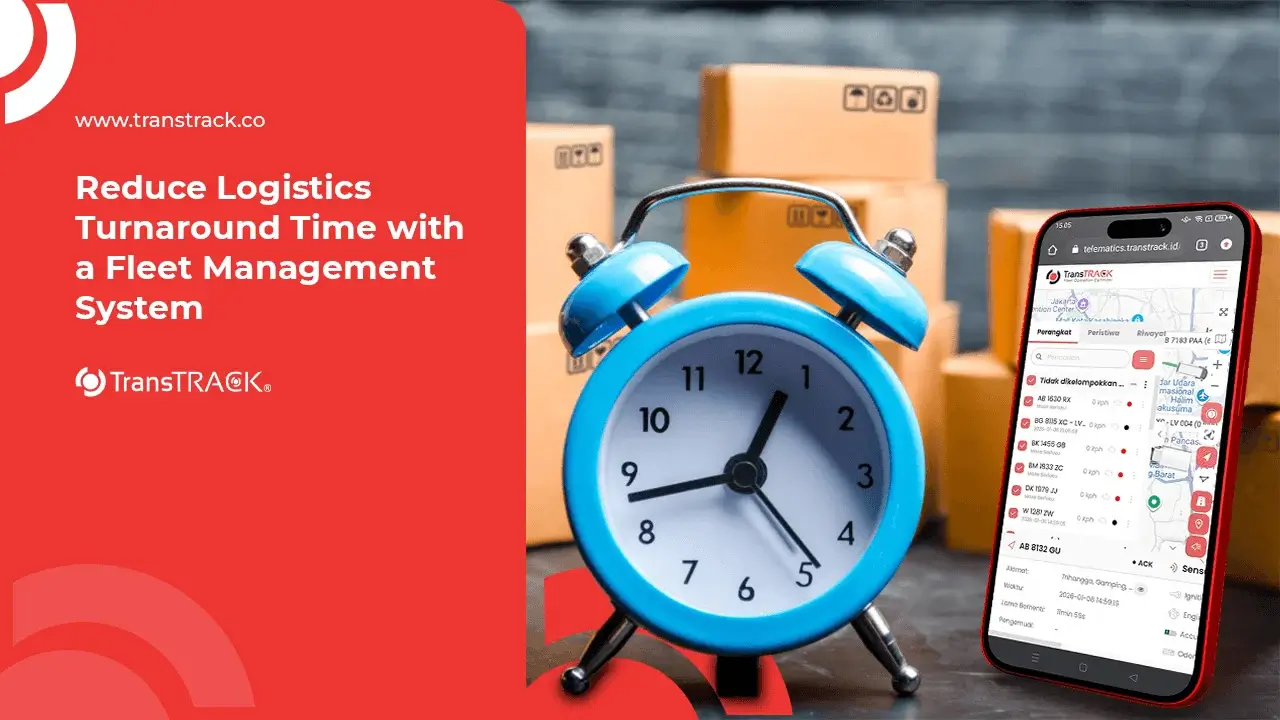
Learn strategies to speed up Turnaround Time and loading and unloading of assets using Fleet Management System technology.
Time is the most valuable asset in logistics. Every minute a truck sits idle, whether waiting at the port or idling en route, can result in significant financial losses. Therefore, utilizing technology like a Fleet Management System (FMS) is key. It not only tracks fleet locations in real time but also speeds up operational processes from gate-in to gate-out, reducing turnaround times and improving daily itineraries. Get to know more in this TransTRACK article!
What Is Turnaround Time in Logistics?
Turnaround Time (TAT) in logistics is the calculation of the total time required for a fleet vehicle to complete one operational process cycle, starting from arrival at a location (such as a port or warehouse), carrying out the loading/unloading process, until leaving again to continue the journey and carry out the distribution process. TAT is an important indicator of operational efficiency, where it is directly related to the level of asset utilization and the company’s potential profit. The shorter the time required for a fleet in one TAT cycle, the higher the number of deliveries that can be made, thus positively impacting fleet productivity and overall business profits.
Common Causes of Slow Turnaround Times
Long turnaround times are often not caused by a single factor, but rather by the accumulation of many small obstacles that arise in the field. From manual documentation to lack of coordination between teams, these obstacles can significantly contribute to increased wait times. Here are some common causes of slow turnaround times:
- Manual documentation:The manual process of verifying travel documents (in paper form) can take a lot of time at the security post.
- Schedule uncertainty (ETA):The warehouse is not ready to carry out the loading and unloading process because it is not certain when the truck will arrive.
- Yard Congestion:The accumulation of trucks arriving in the warehouse area due to the lack of proper arrangement of arrival time slots.
- Poor communication:Truck drivers must get out of their vehicles to find the warehouse officer in charge (manual check-in)
How Does a Fleet Management System Speed Up Turnaround Time?
In the world of logistics operations, utilizing and implementing appropriate, rapid, and effective strategies and solutions is a key to success that cannot be ignored. One approach that has proven effective in addressing various challenges is implementing Fleet Management System (FMS) technology. This FMS technology can automate processes, increase visibility, and accelerate coordination between stakeholders. Here are some examples of challenges and solutions offered by FMS:
Accurate Estimated Time of Arrival
- Explanation: Fleet Management System will provide Real-Time (ETA) data regarding the exact schedule of truck arrival so that the warehouse management team can prepare (prepare dock and workforce) before the truck arrives.
Check-in Automation with Geofencing
- Explanation:By using the Geofencing feature, a feature that establishes a virtual boundary in certain areas (such as warehouses and ports), when a truck passes through a predetermined boundary radius, this feature will automatically record the truck’s arrival time (timestamp), eliminating the need for drivers to provide manual reporting. This also applies when the truck leaves the area.
- Benefit:Shorten the time required for administrative processes.
Route Optimization
- Explanation: Ensuring the efficiency of delivery routes by determining the best routes for trucks to pass, routes that are free from traffic jams and require the shortest travel time, so that the loading and unloading process can be carried out earlier.
Historical Data Analysis for Planning
- Explanation:The Fleet Management System records data on how long a truck spends on average at each point (dwelling time) and then this data is used to evaluate the performance of vendors or warehouse management teams.
Case Study: Impact of Turnaround Time Efficiency
| Metric | Manual Process (Without FMS) | With Fleet Management System |
| Time Recording | Manual (Prone to Human Error) | Otomatis (Geofence Timestamp) |
| Waiting Time | High (warehouse not ready( | Low (warehouse ready via ETA notification) |
| Communication | Repeated calls/WA | Automatic system notification |
| Fleet Utilization | 1-2 Rit per day | Can be increased to 3 Rits per day |
Conclusion
Shortening turnaround times is an efficient strategy every business must implement to increase profitability in logistics operations without having to increase fleet size. With shorter turnaround times, fleets can operate more frequently in a day, increasing trips and optimizing asset utilization. Furthermore, time efficiency will have a direct and significant impact on customer satisfaction due to faster and more timely deliveries.
Increase your fleet’s productivity by reducing unnecessary waiting time. Try a free demo of TransTRACK’s Geofencing and Route Optimization features now and experience firsthand how technology can streamline your logistics processes.
FAQ
What is the difference between Turnaround Time and Lead Time?
Lead time is the total time from ordering until the goods are received by the customer, while Turnaround Time focuses on the operational cycle process time of the fleet (e.g.: the time the truck is in the port/warehouse area).
How to calculate truck Turnaround Time?
TAT = Gate Out Time – Gate In Time. FMS calculates this automatically using Geofencing.
Why is Turnaround Time important in logistics?
Short turnaround times allow fleets to complete more deliveries in the same amount of time, increasing efficiency and profitability.
What are the factors that can slow down Turnaround Time?
Factors such as manual documentation, schedule uncertainty, congestion in warehouse areas, and poor communication can cause Turnaround Time to be longer.
How does Fleet Management System help speed up Turnaround Time?
FMS helps with features such as geofencing for automatic tracking, route optimization, and digital system integration to speed up check-in and verification processes.
Recent Post





Topic :