Bahasa Indonesia


How Does Adaptive Cruise Control Help Improve Driving Safety?
Posted on April 2, 2026 by Nur Wachda Mihmidati
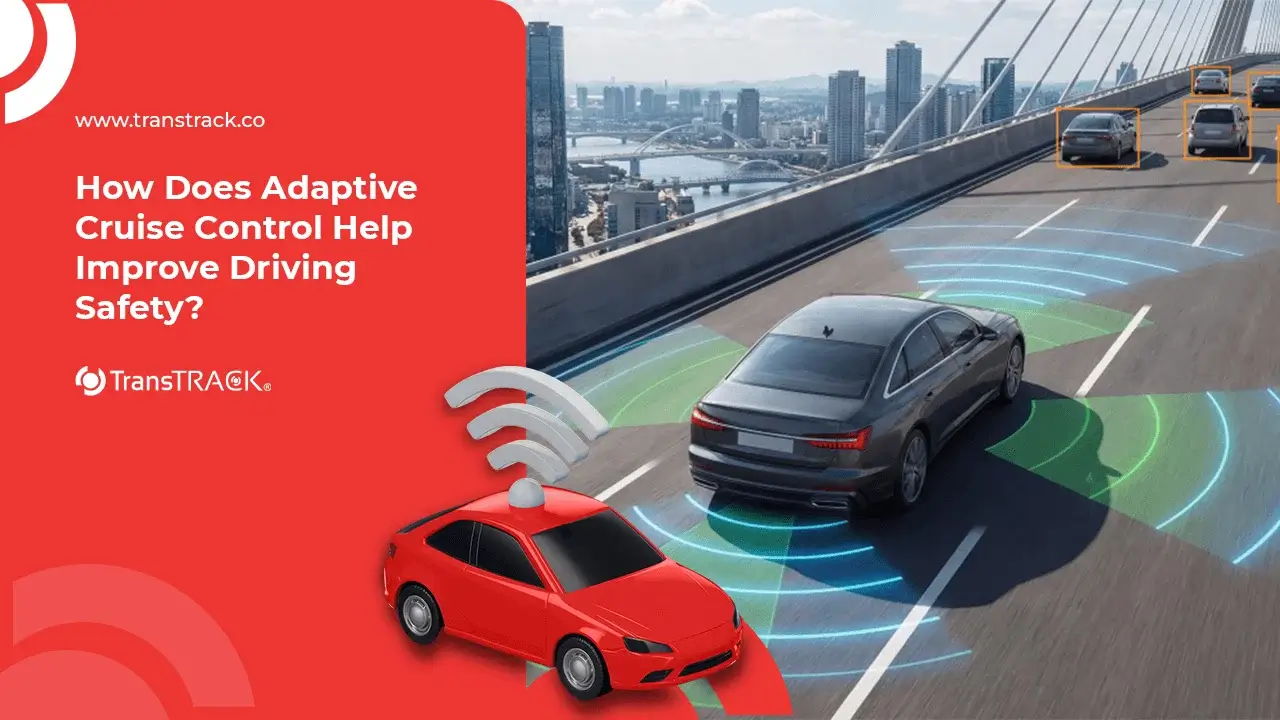
Adaptive Cruise Control (ACC) is a safety and driving comfort feature that automatically adjusts the vehicle’s speed and maintains a safe distance from the vehicle ahead using radar sensors or a camera. This technology helps drivers reduce stress while driving, especially on highways or in heavy traffic, while maintaining control and safety. Read the full explanation in the following TransTRACK article!
What is Adaptive Cruise Control (ACC)?
Adaptive Cruise Control (ACC) is a vehicle feature that automatically adjusts the car’s speed while maintaining a safe distance from the vehicle ahead.
Unlike standard cruise control, which simply maintains a constant speed, ACC uses sensors (such as radar or cameras) to detect vehicles ahead. The system then:
- Slow down if the vehicle ahead slows down
- Increase speed again when the road is less congested (according to the driver’s settings)
- It can even brake automatically under certain conditions
ACC helps drivers stay comfortable on highways or in heavy traffic because the car automatically “follows the flow” of traffic while maintaining a safe distance.
What Is the Main Function of Adaptive Cruise Control?
The primary function of Adaptive Cruise Control (ACC) is to help the driver automatically maintain a safe speed and distance from the vehicle ahead.
More specifically, its main functions include:
- Automatic Safe Distance Control The system will adjust your speed to prevent you from getting too close to the vehicle ahead.
- Automatic speed control The vehicle can accelerate or decelerate without continuous input from the driver.
- Reducing driver fatigue Especially when driving on highways or in heavy traffic conditions that tend to be stop-and-go.
- Improving driving safety By automatically responding to changes in the speed of other vehicles, the risk of rear-end collisions can be reduced.
How Does Adaptive Cruise Control Work?
The Adaptive Cruise Control (ACC) system operates through an integrated process involving sensors, a processing unit, and the vehicle’s control system to automatically maintain both speed and a safe following distance.
Object Detection
The ACC system uses radar, cameras, or a combination of both to detect vehicles ahead, identify their positions, and measure their speeds in real time.
Distance Calculation (Time-to-Collision)
The data collected is then used to calculate the actual distance and the estimated time to collision (TTC), in order to determine whether driving conditions remain within safe limits.
Control Execution
Based on the calculations, the system will automatically control acceleration and braking, including slowing down, maintaining speed, or accelerating again depending on traffic conditions.
Adaptive vs. Conventional
In a conventional cruise control system, the vehicle simply maintains a constant speed without taking traffic conditions into account, whereas ACC dynamically adjusts speed and distance from the vehicle ahead to enhance driving safety and comfort.
Types of Adaptive Cruise Control
The Adaptive Cruise Control (ACC) system comes in several variants designed to accommodate different driving needs, levels of automation, and traffic conditions.
Full Speed Range ACC / Stop-and-Go
This model is the most feature-rich ACC system, as it can operate from high speeds down to a complete stop. The system will:
- Slow down until the vehicle comes to a stop in heavy traffic
- Resume acceleration automatically when road conditions permit
- Highly effective for conditions such as traffic jams and heavy urban traffic
Partial Cruise Control
This type has a more limited range of functionality compared to Full Speed Range ACC. The system only operates within a specific speed range and typically:
- Unable to bring the vehicle to a complete stop
- Requires driver intervention in traffic jams or at very low speeds
- Generally used in early-generation ACC systems or certain vehicle classes
Predictive ACC
This type represents a further development that combines sensor data with predictive information, such as maps or road conditions. This system can:
- Anticipate curves, hills, or changes in speed limits
- Adjusting speed before conditions change
- Proactively improving driving efficiency and comfort
In summary, the main differences among these three types of ACC lie in operating speed range, level of automation, and the system’s ability to predict road conditions.
Benefits of Using ACC
Adaptive Cruise Control (ACC) offers a range of benefits designed to enhance the driving experience in terms of comfort, safety, and vehicle operational efficiency.
Driving Comfort
ACC helps reduce driver fatigue by automatically adjusting speed and maintaining a safe following distance. Drivers don’t have to constantly press the accelerator and brake pedals, especially during long trips or in heavy traffic, making the journey more relaxed and less tiring.
Security
The ACC system actively maintains a safe distance from the vehicle ahead and automatically responds to changes in speed. This helps reduce the risk of rear-end collisions, especially in changing or unpredictable traffic conditions.
Fuel Efficiency
By maintaining a more consistent speed and minimizing sudden acceleration and braking, ACC helps create a more efficient driving pattern. This can contribute to fuel savings and reduce wear and tear on vehicle components.
Risks to Be Aware Of When Using Adaptive Cruise Control
Although Adaptive Cruise Control (ACC) enhances driving comfort and safety, the system still has limitations that drivers need to understand to ensure its optimal and safe use.
Bad Weather
In heavy rain, thick fog, or snow (in countries with four seasons), the performance of radar and camera sensors may be reduced. This can result in:
- Vehicle detection becomes less accurate
- System response is slow or suboptimal
- Potential challenges in maintaining a safe distance
Static Object Detection
ACC is generally more effective at detecting moving objects. Under certain conditions, the system may have difficulty recognizing:
- A vehicle that stops suddenly
- Stationary objects on the road (such as broken-down vehicles or obstacles)
- A sudden emergency
Driver Dependency
Excessive use of ACC can lead to a risk of dependency, in which the driver:
- Becoming less vigilant about road conditions
- Failing to take control in time when the system is unable to respond to a particular situation
- Ignoring the fact that ACC is an assist system, not a replacement for the driver
Overall, ACC still requires active driver attention, as the system is designed to be a safety aid, not a substitute for full control of the vehicle.
Conclusion
Adaptive Cruise Control (ACC) is a driver-assistance technology that plays a key role in enhancing driving comfort, safety, and efficiency. By detecting vehicles ahead, automatically adjusting speed, and maintaining a safe following distance, ACC helps reduce driver fatigue, particularly during long-distance trips and in heavy traffic.
However, the use of ACC still has its limitations, so drivers need to remain alert and not rely entirely on the system. Factors such as weather conditions, stationary objects, and complex traffic situations still require human attention as the primary controller of the vehicle.
To support improved safety and more comprehensive vehicle monitoring, technology-based solutions such as the Vehicle Surveillance System from TransTRACK can serve as an effective complement. This system helps provide better real-time visibility into vehicle conditions and operations, enabling faster, more accurate, and data-driven decision-making.
FAQ
What is the difference between Adaptive Cruise Control and Autopilot?
Adaptive Cruise Control (ACC) only regulates speed and maintains a safe distance from the vehicle ahead, whereas Autopilot (Level 2+ autonomous) has additional capabilities to assist with or take over steering control under certain conditions.
Can a car with ACC stop on its own?
Yes, if the vehicle is equipped with the Stop & Go feature, the ACC system can slow down to a complete stop when the vehicle ahead also stops, and then resume driving when conditions permit.
Is the ACC safe to use during heavy rain?
Its use is not recommended in heavy rain or low-visibility conditions. The radar sensor and camera may be affected by water or thick fog, which can reduce detection accuracy.
Can I take control while ACC is active?
Yes. The driver can still take control at any time. Pressing the brake or accelerator pedal manually will automatically deactivate the ACC system for driving safety.
Can ACC be used on all types of roads?
Not always. ACC works best on highways or roads with steady traffic flow. On roads that are too congested, winding, or lack clear lane markings, its performance may be reduced.
Does Adaptive Cruise Control require special maintenance?
Not specifically, but sensors such as radar and cameras need to be kept clean to prevent them from becoming covered in dirt, dust, or mud, which can interfere with system performance.




Topic :