Bahasa Indonesia


Mining Fleet Management System for Improved Productivity and Workplace Safety
Posted on April 23, 2026 by Nur Wachda Mihmidati
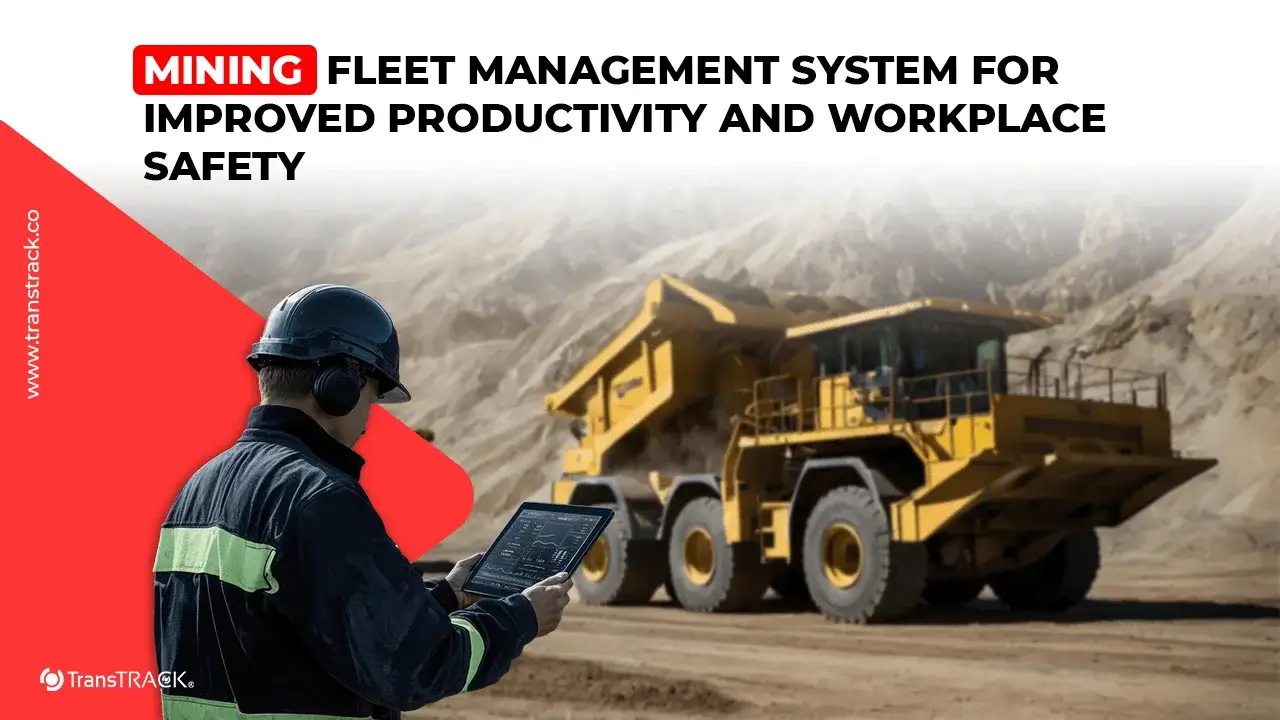
A mining fleet management system is a technology-based system used to monitor, manage, and optimize all vehicle and heavy equipment operations in the mining area in real time.
In the mining industry, FMS is more than just vehicle tracking—it serves as an operational control center to ensure productivity, safety, and cost efficiency. Read the full explanation in the following TransTRACK article!
What is a Fleet Management System (FMS) for the mining industry?
A Fleet Management System (FMS) in mining is a digital solution that integrates GPS, sensors, and analytical software to monitor fleet movements, manage the deployment of heavy equipment, optimize haulage routes, and improve overall safety and operational efficiency in mining operations.
What is the purpose of using a fleet management system for a mine?
In mining operations, a system is needed that can help manage the fleet more effectively and efficiently. The Fleet Management System (FMS) is designed to support this.
Here are some of the main purposes of using a Fleet Management System (FMS) in the mining industry:
1. Improving Operational Productivity FMS helps ensure that every piece of heavy equipment operates at optimal capacity by reducing idle time and speeding up cycle times (loading–hauling–dumping).
2. Optimizing Fleet Utilization Avoiding both underutilization and overutilization through more accurate scheduling and dispatching based on on-site conditions.
3. Reducing Operating Costs Reducing fuel consumption, extending the lifespan of heavy equipment, and lowering maintenance costs through real-time usage monitoring.
4. Improving Workplace Safety Detecting risky behaviors such as speeding, sudden braking, and unsafe work practices, thereby minimizing the risk of accidents.
5. Improving Planning and Decision-Making Accuracy The operational data generated by the FMS is used for production analysis, equipment performance evaluation, and more precise long-term planning.
6. Ensuring Operational and Regulatory Compliance Helping mining companies meet the safety, reporting, and operational audit standards required by regulations.
7. Improving Operational Transparency All fleet activities can be monitored in real time, thereby reducing potential inefficiencies and fraud in the field.
Critical Features of the Mining-Specific FMS
Mining FMS systems are equipped with a variety of critical features to ensure safe, efficient, and real-time controlled operations. Here are the key features:
- High-Precision GPS & Geofencing Provides accurate tracking of heavy equipment locations down to the work area level (pit, dump point, hauling road) for precise operational control.
- Payload & Cycle Time Monitoring Monitoring payload and cycle time (loading–hauling–dumping) to optimize productivity and operational efficiency.
- Fatigue Management System Detects potential operator fatigue through work patterns, operating hours, and behavioral data to improve workplace safety.
- The Proximity Detection System (PDS) provides early warnings of potential collisions between heavy equipment or dangerous proximity in mining work areas.
- Engine Health Telemetry Monitors engine conditions in real time, such as temperature, pressure, fuel consumption, and fault codes, to support preventive maintenance.
The operational impact of a mining fleet management system
FMS in mining operations has a direct impact on operational efficiency, costs, and overall asset performance. Here are some of the key impacts:
Reduced operating costs & increased production
FMS helps optimize the use of heavy equipment and hauling workflows, thereby reducing wait times and increasing production output while improving cost efficiency.
Fuel saving & cost saving
By monitoring fuel consumption and operator behavior in real time, the FMS can reduce fuel waste, idle time, and unnecessary maintenance costs.
Increased equipment utilization and ready hours
FMS ensures that every piece of heavy equipment is used to its full potential and does not sit idle for long periods, thereby increasing fleet availability and productivity.
Improved workplace safety & corporate reputation
Systems such as operator behavior monitoring and risk alerts help reduce the potential for workplace accidents, which ultimately improves safety and the company’s reputation in the industry.
Implementation Challenges & Solutions
The implementation of FMS in mines often faces technical and operational challenges that must be properly managed to ensure the system operates optimally. Here are some of the main challenges and their solutions:
Connectivity
Challenge: Mining sites often have limited signal coverage, so data isn’t always transmitted in real time. Solution: Use a combination of networks (satellite, radio, offline sync) and edge computing to ensure data is stored and synchronized when a connection becomes available.
Operator Adoption
Challenge: Heavy equipment operators sometimes have difficulty adapting to new systems or lack discipline in their use. Solution: Regular training, a simple user interface, and a change management approach to improve user acceptance and compliance.
Data Silos
Challenge: Operational data is scattered across various systems (dispatch, maintenance, fuel), making it difficult to analyze comprehensively. Solution: An end-to-end FMS platform integration that consolidates all data into a single centralized dashboard for more accurate decision-making.
Conclusion
Overall, Fleet Management Systems (FMS) in the mining industry play a critical role in boosting productivity, reducing operational costs, enhancing workplace safety, and providing full visibility into the entire fleet and field operations. With real-time data-driven management, mining companies can make faster, more accurate, and strategic decisions to continuously improve operational performance.
Improve the efficiency and operational control of your mine with TransTRACK’s Fleet Management System for a more integrated, secure, and data-driven solution.
FAQ
What are the main benefits of a Fleet Management System for mining companies?
The main benefits include a 15% increase in hauling productivity, reduced fuel costs, extended tire life for heavy equipment, and improved workplace safety standards through real-time monitoring of operator behavior.
How does FMS work in mining areas with no signal (dead zones)?
Modern FMS systems use private Wi-Fi mesh networks or satellite communications to ensure that data is transmitted in real time even in remote locations without cellular coverage.
How does FMS improve occupational health and safety (OHS) at the mine?
FMS enhances occupational safety and health by monitoring operator behavior—such as speeding, fatigue, and sudden braking—in real time, and providing early warnings through the Proximity Detection system to prevent potential accidents in the mining work area.
Can the Fleet Management System be integrated with other mining systems?
Yes, FMS can be integrated with other systems such as maintenance management, fuel management, and mining ERP to create a more connected and efficient operational ecosystem.
Does the implementation of FMS require major changes to mine operations?
Not necessarily. FMS implementation can be carried out in phases according to operational needs, using an adaptive approach to avoid disrupting ongoing production processes.
Recent Post





Topic :