Bahasa Indonesia


Maritime Transportation Regulations and Compliance Challenges in the Digital Age
Posted on February 19, 2026 by Nur Wachda Mihmidati
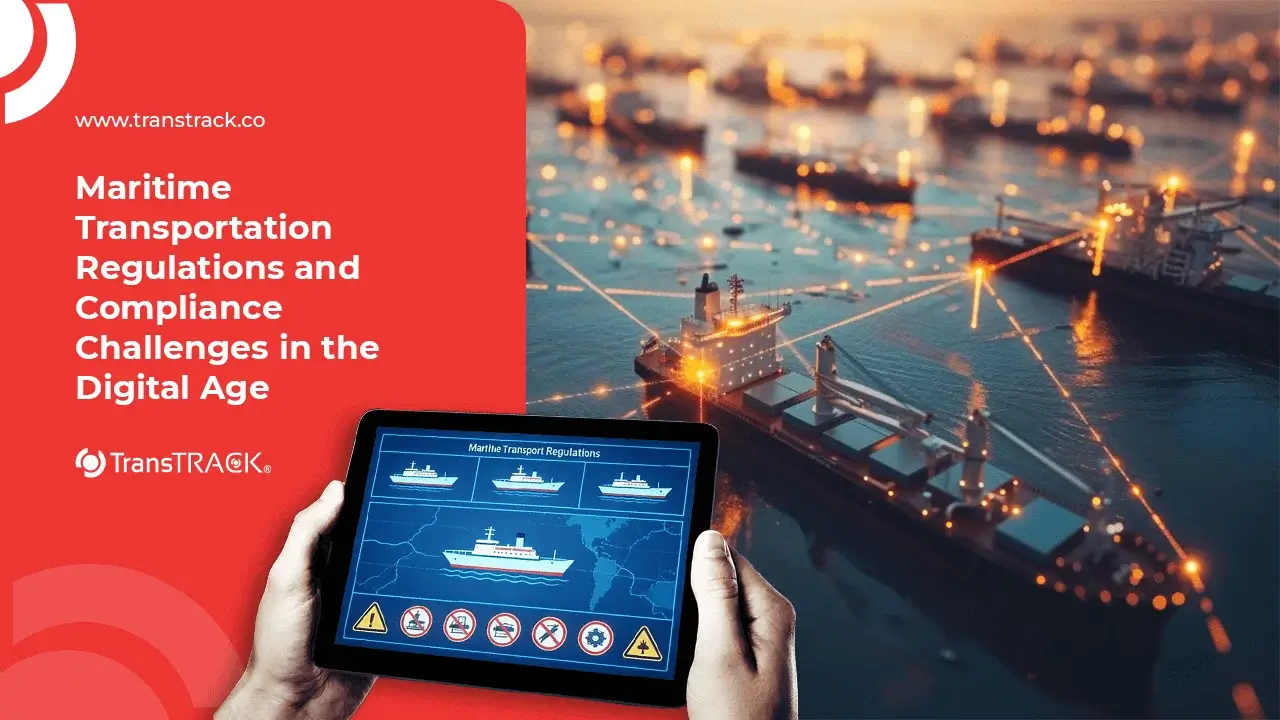
The shipping industry is under increasing pressure: demands for safety, regulatory compliance, operational efficiency, and data transparency go hand in hand. It is no longer enough for ship operators to simply ensure that their fleets move from port to port—they must be able to prove that every voyage meets national and international standards.
This is where TransTRACK comes in as a maritime digitization partner. With real-time visibility, ship data integration, and a centralized monitoring system, TransTRACK helps companies turn compliance into a measurable, documented, and easily monitored process. The result is not only safer operations, but also faster, data-driven decision making.
With the right technology, regulatory challenges can be turned into opportunities for improved performance and competitiveness.
Why is Regulatory Compliance Crucial?
In maritime operations, regulations serve as a safety net for people, business continuity, and marine conservation. Compliance is not only a legal requirement, but also an investment to minimize long-term risks.
Safety at Sea
Through international standards such as SOLAS, every ship is required to meet construction, equipment, and safety procedure requirements. By following these rules, crew and passengers have clear protection when facing emergency conditions.
Legal and Financial Impact
Regulatory violations can trigger heavy fines, ship detention, lawsuits, and even revocation of operating licenses. Enforcement coordinated by the International Maritime Organization also makes compliance standards applicable across countries, putting a company’s reputation at stake.
Protection of Marine Ecosystems
Environmental regulations such as MARPOL require operators to control waste disposal, emissions, and potential spills. Compliance means playing an active role in keeping the ocean productive and sustainable.
When regulations are followed, operations become safer, more reliable, and ready to compete at a global level.
Legal Basis for Maritime Transportation in Indonesia
Maritime transportation in Indonesia is operated within a structured legal framework, ranging from laws to technical regulations. The aim is to ensure safety, orderly trade, and protection of the maritime environment.
Law No. 17 of 2008 on Navigation
Law No. 17 of 2008 concerning Shipping is the main foundation of national maritime governance. This regulation governs aspects of safety, security, sea transportation, ports, and the roles of the government and private sector in shipping operations.
Government Regulation (PP)
As derivative regulations, various government regulations provide more detailed operational guidelines, including water transportation management, port service standards, and monitoring mechanisms. With these regulations, implementation in the field has clear and uniform references.
The Role of the Ministry of Transportation & Director General of Sea Transportation
The Ministry of Transportation of the Republic of Indonesia, through the Directorate General of Sea Transportation, acts as both regulator and supervisor. They set policies, conduct certification and safety inspections, and ensure that all business operators comply with applicable regulations.
With this legal structure, Indonesia’s maritime transportation activities can run more safely and orderly, and provide regulatory certainty for the business world.
International Standards: The Role of the IMO (International Maritime Organization)
Safety and security standards are not only set by individual countries. The International Maritime Organization (IMO) is the body that formulates various conventions so that ship operations around the world follow uniform guidelines.
SOLAS Convention
SOLAS sets minimum requirements for ship construction, safety equipment, navigation systems, and emergency procedures to protect crew and passengers.
MARPOL Convention
Through MARPOL, the industry is required to prevent marine pollution caused by oil, hazardous waste, sewage, and emissions from ships.
STCW
STCW sets international standards for training, certification, and watchkeeping for seafarers, ensuring that the competence of ship crews in different countries remains equivalent.
ISPS Code
The ISPS Code strengthens ship and port facility security systems, including threat identification and risk prevention procedures.
With this framework in place, international shipping can be safer, more efficient, and more reliable across national borders. If necessary, I can help summarize it into an infographic or presentation material.
Important Aspects of Maritime Transportation Regulations
Maritime transportation regulations cover various technical and administrative aspects to ensure that every vessel in operation meets applicable safety, competency, and logistics management standards.
Seaworthiness of Ships
Before sailing, ships must meet technical requirements, ranging from structure, engines, navigation equipment, to safety equipment. These inspections and certifications ensure that ships are safe for the crew, cargo, and the environment.
Ship Crew Certification
Each crew member must have the competencies required for their position, as evidenced by an official certificate. This requirement is in line with international standards such as the STCW, thereby ensuring the quality of human resources.
Cargo and Logistics Regulations
The transport of goods, especially dangerous goods, follows the guidelines of the IMDG Code. These regulations govern classification, labeling, documentation, and handling procedures to minimize risks during shipping.
Route and Operational Permits
Sea transportation companies must have business licenses such as SIUPAL as proof of operational legality. Without this license, commercial shipping activities are not permitted.
By complying with all these aspects, maritime operations can be conducted more safely, orderly, and with legal certainty.
Latest Changes in Maritime Regulations
The shipping industry continues to evolve in line with global dynamics, making regulatory updates inevitable. A number of recent policies emphasize service efficiency, environmental sustainability, and ease of doing business.
Licensing Digitalization
The government is promoting service integration through Inaportnet, an electronic platform for ship clearance and port administration processes. This system speeds up bureaucracy, increases transparency, and reduces the potential for manual errors.
Sustainability & Target Emisi
The commitment to reducing emissions is growing stronger in line with the International Maritime Organization’s agenda towards the 2030 and 2050 targets. Ship operators are now required to implement energy efficiency, use cleaner fuels, and report on environmental performance.
Post-Job Creation Law Adjustments
Through the Job Creation Law, the government is simplifying various licensing and investment processes in the maritime sector. The goal is to create a more competitive business climate without compromising safety and oversight.
With this new policy direction, industry players need to be more adaptive in order to remain compliant while being able to take advantage of growth opportunities.
The Impact of Regulatory Violations on Companies
Non-compliance with maritime regulations has serious consequences, not only for operations but also for the sustainability of the company’s business. Legal, financial, and reputational risks can arise simultaneously.
Revocation of Business License
The authorities may freeze or revoke licenses such as the SIUPAL and SIUPSUS. Without these licenses, companies cannot legally operate maritime transportation activities.
Criminal Sanctions and Administrative Fines
Certain violations—particularly those related to safety or pollution—can result in criminal proceedings in addition to fines. These costs are often much greater than the investment required to comply from the outset.
Prohibition of Mooring at International Ports
Through the Port State Control mechanism, ships that do not meet standards can be detained. The impact includes delivery delays, contract penalties, and a decline in global customer confidence.
Therefore, compliance is not merely a matter of following rules, but rather a strategic step to maintain business continuity and reputation in the international market.
Conclusion
Maritime transportation regulations continue to evolve in response to demands for safety, security, efficiency, and environmental sustainability. From ship seaworthiness and crew competence to operational oversight, all of these require companies to have accurate, real-time data visibility. Without the right system support, compliance can easily become a complex administrative burden.
Through the use of TransTRACK’s Vessel Monitoring System, operators can monitor vessel movements, operational status, and sailing history on a single integrated platform. This data helps ensure that international standards are met, facilitates reporting to regulators, and reduces the risk of sanctions and vessel detention.
It’s time to make compliance a competitive advantage. Optimize your fleet monitoring with TransTRACK’s digital solutions and run safer, more transparent maritime operations that are ready to meet global regulatory demands.
FAQ: Maritime Transportation Regulations
What is the legal basis for maritime transportation in Indonesia?
The main basis is Law No. 17 of 2008 concerning Shipping, which regulates safety, security, environmental protection, and maritime trade. However, in practice, its implementation is further elaborated through various derivative regulations and technical provisions from the Directorate General of Sea Transportation, so that the details of the obligations may differ depending on the type of business and area of operation.
Who regulates international maritime transport?
Global standards are set by the International Maritime Organization. Each country, including Indonesia, then ratifies and adopts them into national law. Therefore, their implementation may be subject to administrative adjustments in accordance with each country’s policies.
What are the mandatory documents for a ship to sail?
Generally, these include the Certificate of Registry, Safety Certificate, Tonnage Certificate, Certificate of Seafarer’s Competency, and crew certificates. However, certain ships—such as tankers, passenger ships, or ships carrying dangerous goods—usually require additional documents according to their operational characteristics.
What are the environmental regulations for maritime transport?
International regulations refer to MARPOL, which restricts the discharge of oil, plastic, and hazardous substances. In Indonesia, these regulations are implemented through national regulations and administrative and inspection requirements, with details that may vary depending on the type of ship and its activities.
Recent Post




Topic :