Bahasa Indonesia


Bunker Fuel Efficiency Strategies in the Era of Digital Monitoring
Posted on January 29, 2026 by Nur Wachda Mihmidati
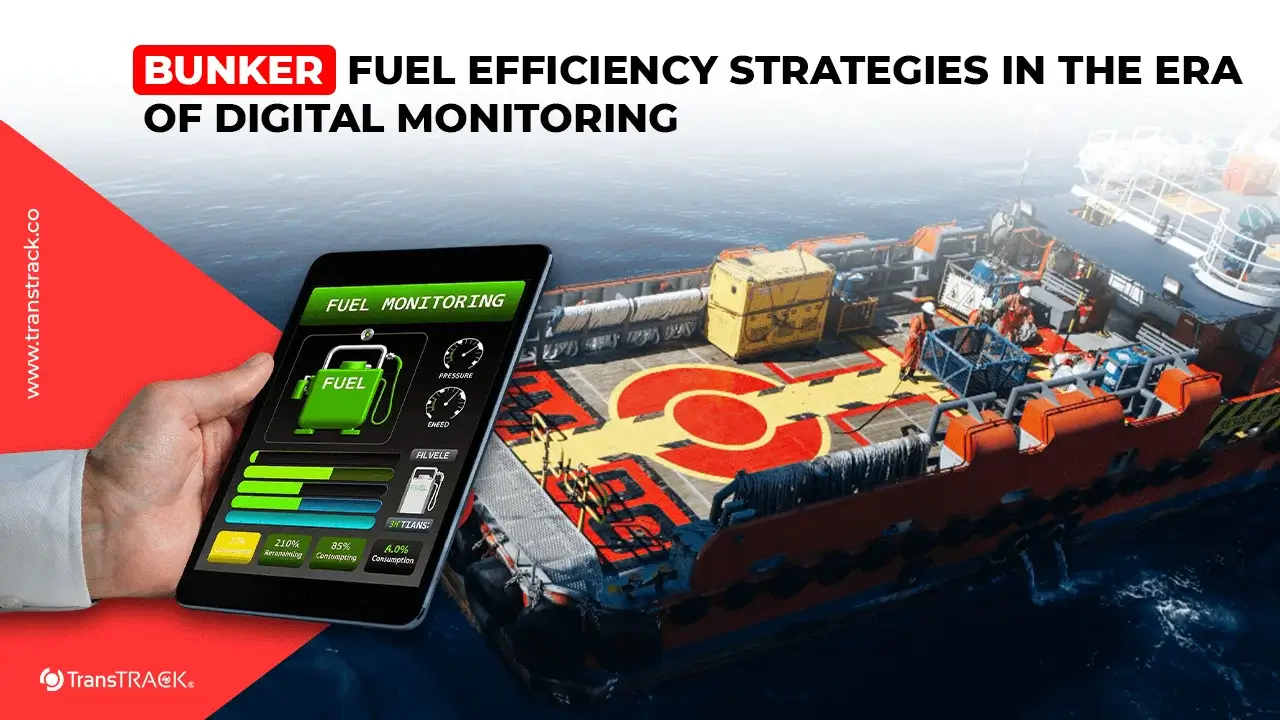
Bunker fuel plays a crucial role in determining the operational efficiency and competitiveness of the shipping industry. With costs that can account for more than half of total operating expenses, fuel consumption management is no longer just a technical issue, but a business strategy. Amidst demands for efficiency and increasingly stringent environmental regulations, understanding the types of marine fuel and how to control it digitally has become a key requirement for operators and fleet owners. Read the full explanation in the following TransTRACK article!
Understanding the Types of Marine Fuel (Bunker Fuel)
The choice of marine fuel greatly affects cost efficiency, engine performance, and compliance with environmental regulations. Each type of bunker fuel has different characteristics, emission levels, and uses. The following are the most commonly used types of marine fuel.
- MFO (Marine Fuel Oil)
MFO is a high-viscosity residue-based fuel used in the main engines of large ships. It generally requires a heating system to burn optimally and is chosen because it is more economical.
- MDO and MGO
MDO and MGO are cleaner distillate fuels. MDO still contains some residue, while MGO is purer and lower in sulfur. MGO is commonly used in areas with strict emissions regulations or when ships are in port.
- HFO (Heavy Fuel Oil)
HFO has very high viscosity and high sulfur content. Its use has been increasingly restricted since the IMO 2020 regulation set a maximum sulfur limit of 0.5%.
Comparison Table
| Type of Fuel | Viscosity | Relative Price | Environmental Impact |
| HFO | Very high | Cheapest | Height |
| MFO | Height | Murah | Currently |
| MDO | Low | Middle | Lower |
| MGO | Very low | Mahal | Lowest |
Factors Contributing to Excessive Fuel Consumption by Ships
Fuel consumption wastefulness in ships is generally influenced by a combination of technical, operational, and external factors, including non-technical risks that often escape scrutiny.
Technical Factors
A dirty hull due to biofouling, damaged propellers, and reduced engine performance cause the ship to require more power and increase fuel consumption.
Human and Operational Factors
Unstable ship speeds or speeds exceeding optimal limits, as well as inefficient route selection, lead to uncontrolled fuel consumption.
External Factors
Bad weather, ocean currents, and wind resistance increase the workload on the engine and directly impact fuel consumption.
Illegal Depreciation
Fuel theft and fuel consumption report manipulation remain hidden causes of increased ship operating costs.
What is a Vessel Monitoring System (VMS) and its Role in Efficiency?
A Vessel Monitoring System (VMS) is a ship monitoring system that utilizes satellite or cellular communications to monitor the position, movement, and operational status of ships in real time. VMS data helps operators improve operational efficiency, sailing safety, and fuel cost control.
VMS functions as a communication and monitoring system that transmits data on vessel position, speed, route, and other operational parameters to a control center. This information is used for fleet monitoring and data-driven decision making.
How Fuel Sensors Work
The fuel sensor works by integrating a digital flow meter into the ship’s telematics system. The flow of fuel entering and leaving the engine is automatically recorded, then sent to the VMS platform to be analyzed as actual consumption data.
All data from the VMS is displayed in a digital dashboard that shows a map of vessel movements, fuel consumption graphs, and key performance indicators, facilitating quick monitoring and evaluation of efficiency.
Strategies for Saving Fuel Costs with VMS
The Vessel Monitoring System (VMS) enables more precise control of vessel fuel consumption through real-time operational data. Here are the main strategies that can be implemented to reduce fuel costs.
Speed Optimization (Eco-Speed)
VMS helps determine the most efficient ship speed so that fuel consumption is at the best ratio without compromising the sailing schedule.
Monitoring Real-Time
Direct monitoring of fuel consumption facilitates the detection of unusual spikes that may indicate fuel leakage or theft.
Smart Route Analysis
Historical and real-time data from the VMS is used to select more efficient routes by avoiding oncoming traffic and adverse weather conditions.
Automatic Report (Daily Report)
Fuel consumption is recorded automatically, reducing human error and improving the accuracy of operational reports.
Case Study/Savings Estimation (Data-Driven)
The implementation of the Vessel Monitoring System (VMS) has a direct impact on the fuel cost efficiency of ships through data-based monitoring.
Comparison of Costs Before and After VMS
Before using VMS, fuel consumption was generally calculated based on manual reports and estimates, making it prone to waste. After VMS was implemented, fuel consumption can be monitored in real time, ship speed is more controllable, and potential leaks or illegal shrinkage can be detected more quickly. As a result, annual fuel costs can be significantly reduced.
VMS ROI Estimate
Investments in VMS devices can typically be recouped in a relatively short period of time through fuel savings, reduced operating costs, and increased data transparency. In many operational cases, annual fuel savings are sufficient to cover the cost of implementing VMS, giving the system a positive and sustainable ROI.
Conclusion
Fuel is the largest cost component in marine vessel operations. Choosing the right type of bunker fuel, controlling consumption, and accurate operational monitoring are key to improving efficiency and reducing waste. Without real-time data support, potential inefficiencies, operational errors, and illegal depletion will be difficult to control.
With TransTRACK’s Vessel Monitoring System (VMS), shipping companies can monitor vessel movements, fuel consumption, speed, and routes in an integrated manner on a single platform. Accurate and transparent data helps enable faster, more efficient, and performance-based decision making.
It’s time to switch from manual recording to digital monitoring. Optimize your marine fuel usage with the TransTRACK Vessel Monitoring System for sustainable cost efficiency and more controlled maritime operations.
FAQ: Bunker Fuel
What is the most commonly used fuel for ships?
HFO (Heavy Fuel Oil) and MFO (Marine Fuel Oil) are used on large ships because they are more economical.
MDO (Marine Diesel Oil) and MGO (Marine Gas Oil) are used when ships are in port or in strict emission control areas.
How much fuel does a large container ship consume?
Large container ships consume around 100–200 tons per day.
Consumption is influenced by ship size, operating speed, and weather conditions.
What are the differences between HFO, MFO, MDO, and MGO?
HFO/MFO: high viscosity, cheaper, greater emissions.
MDO/MGO: low viscosity, cleaner, higher cost.
How does the IMO 2020 regulation affect marine fuel?
IMO 2020 limits the maximum sulfur content to 0.5%.
Ship operators must use low-sulfur fuel oil, install scrubbers, or switch to alternative fuels.
How does VMS help reduce ship carbon emissions?
Eco-speed reduces fuel consumption and emissions.
Real-time monitoring prevents waste and illegal depletion.
Data-driven route analysis avoids conditions that increase emissions.
Can fuel consumption monitoring be done in real time?
Yes, through the Vessel Monitoring System (VMS) integrated with sensors and digital flow meters.
Consumption data is recorded automatically and is auditable.





Topic :