Bahasa Indonesia


Breakdown Maintenance is the Most Expensive Maintenance Strategy and Should Be Abandoned
Posted on December 10, 2025 by Nur Wachda Mihmidati
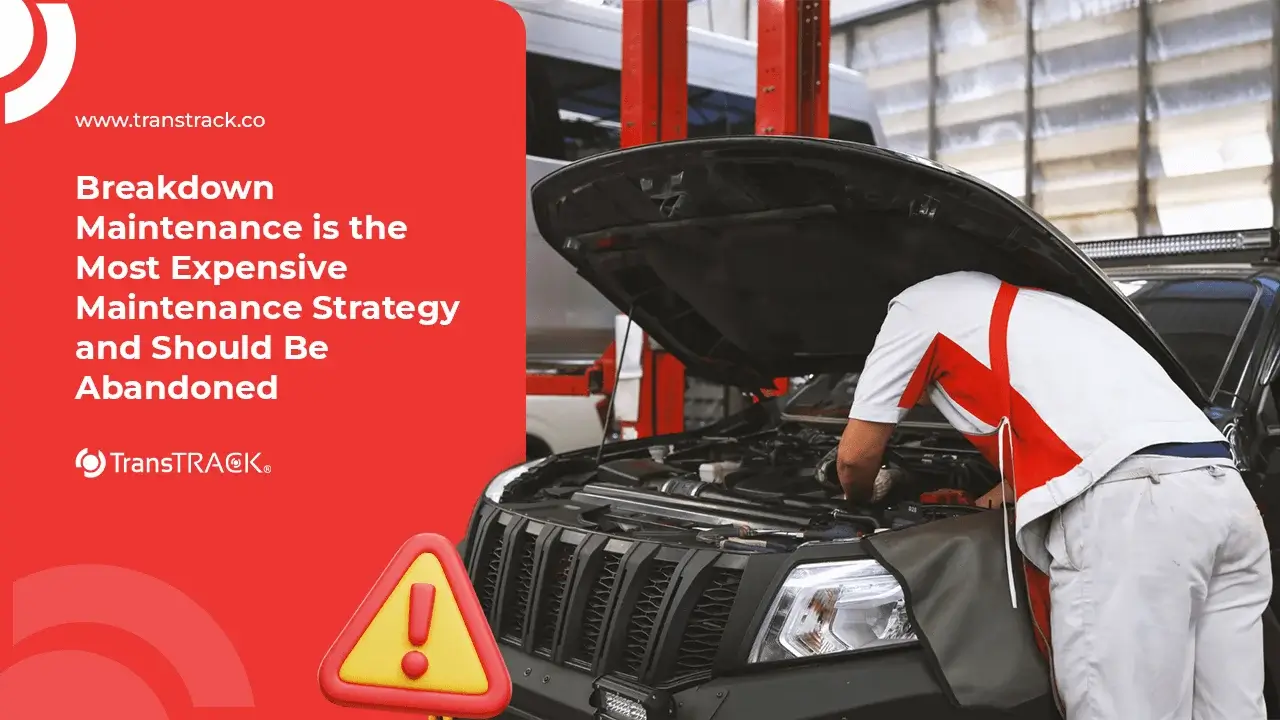
Breakdown maintenance is a situation where an asset such as a truck, machine, or heavy equipment is left to completely fail before being repaired. This strategy is, in fact, the most potentially costly maintenance strategy, even though it may seem the easiest, as it is only performed when damage occurs. Breakdown maintenance is a form of reactive maintenance performed as a corrective action after a malfunction, and its costs often far exceed the cost of the repair itself—including various other losses, including time and reputation. Get to know more in this TransTRACK article!
Negative Financial and Operational Impacts of Breakdown Maintenance
Breakdown maintenance not only causes assets to stop operating completely, but can also result in significant unforeseen costs. Any sudden breakdown can halt entire workflows, cause distribution delays, and lose business opportunities and reputation. Furthermore, emergency costs such as towing services, urgent replacement parts, and technician overtime can significantly burden a company’s finances. Here are some of the negative impacts of breakdown maintenance:
Much Higher Repair Costs
- Detail: Collateral damage, for example, engine damage caused by running out of oil
- Cost:Emergency spare parts and technician overtime costs
Loss of Time and Productivity
- Detail:A broken down truck means a stopped trip, late penalties, and idle time.
- Impact: Disrupting the entire logistics operational schedule
Security and Reputation Risks
- Detail:Sudden breakdowns (e.g. brake failure or a sudden tire burst) can cause fatal accidents.
- Impact: Damage to the company’s image in the eyes of clients
Comparison: The Evolution of Asset Maintenance Strategies
| Category | Breakdown Maintenance (Reactive) | Preventive Maintenance (Scheduled) | Predictive Maintenance (Cerdas) |
| When is it done? | After the asset fails | Based on the specified time/km | Based on the actual condition of the asset |
| Cost | Very high (emergency) | Moderate (replace spare parts that are still good) | Lowest (time optimization) |
| Detector | Total failure | Calendar/odometer | Sensor/AI/FMS |
| Objective | Restore function | Prevent failure | Optimize the lifespan of spare parts first |
Transition to Preventive and Predictive Maintenance
To avoid recurring losses due to maintenance breakdowns, companies need to shift to a more proactive strategy. Preventive and predictive maintenance offer a long-term approach that focuses on preventing damage before it occurs. With scheduled, data-driven maintenance, companies can keep assets running optimally while reducing the cost of unexpected repairs.
First Step: Implement Preventive Maintenance
- Focus:Change your mindset from waiting for damage to scheduling regular repairs (change oil, filter, check engine and fuel)
- AIDS:Use FMS for service notifications based on actual KM, not estimated dates.
End Goal: Achieve Predictive Maintenance
- Focus:Using IoT (diagnostic sensors) and AI/ML to predict when a component will fail (start to malfunction)
- AIDS: FMS such as (TransTRACK) which processes engine sensor data to estimate remaining component life.
The Role of FMS Technology in Eliminating Breakdown Maintenance
Managing fleet maintenance can no longer rely solely on reacting to fleet breakdowns, which will only lead to greater losses in the future. Today, technologies like Fleet Management Systems (FMS) enable real-time, accurate, and predictive vehicle condition monitoring. By leveraging an FMS, companies can transition to a smarter, more scalable maintenance approach without drastically changing their entire operational system. Here are some examples of how an FMS can help eliminate breakdown maintenance:
- Asset Health Monitoring:FMS sensors monitor engine conditions in real-time and accurately (temperature, oil pressure)
- Notification Religious Defect:Drivers can report minor problems (defects) via the digital Vehicle Inspection application before leaving.
- Audit Trail: FMS records repair history, ensuring no service or component parts are missed.
Conclusion
Breakdown maintenance is a seemingly simple and practical maintenance practice, but it carries the greatest risks and costs in the long run. Switching to preventive and predictive maintenance, supported by data from a fleet management system, is a strategic solution to ensure cost efficiency and fleet availability. This approach enables companies to be better prepared to face operational challenges without sacrificing productivity.
Don’t let your fleet fall victim to breakdown maintenance. Start optimizing your service schedule with TransTRACK FMS. Contact us for a demo of our Predictive Maintenance solution.
FAQ
What are the main advantages of Predictive Maintenance over Preventive Maintenance?
Predictive Maintenance reduces costs by ensuring parts are only replaced when absolutely necessary, avoiding wasting good parts.
How much money is saved by skipping breakdown maintenance?
Savings can reach 20–40% of total maintenance costs in the long run by eliminating emergency repairs and wasted time.
What is the difference between Preventive and Predictive Maintenance in practice?
Preventive Maintenance is carried out based on a fixed schedule, while Predictive Maintenance is based on the actual condition of the asset using sensors and data.
How does FMS help run Predictive Maintenance efficiently?
FMS monitors vehicle conditions in real-time and provides notifications when certain parameters indicate a risk of damage.
Do small companies also need to implement Predictive Maintenance?
Yes, because this strategy helps reduce operational costs and maintain fleet reliability, regardless of business scale.
Recent Post




Topic :