Bahasa Indonesia

Mandatory Categories of Safety Equipment on Board Ships (In Accordance with SOLAS)
Posted on December 11, 2025 by Nur Wachda Mihmidati
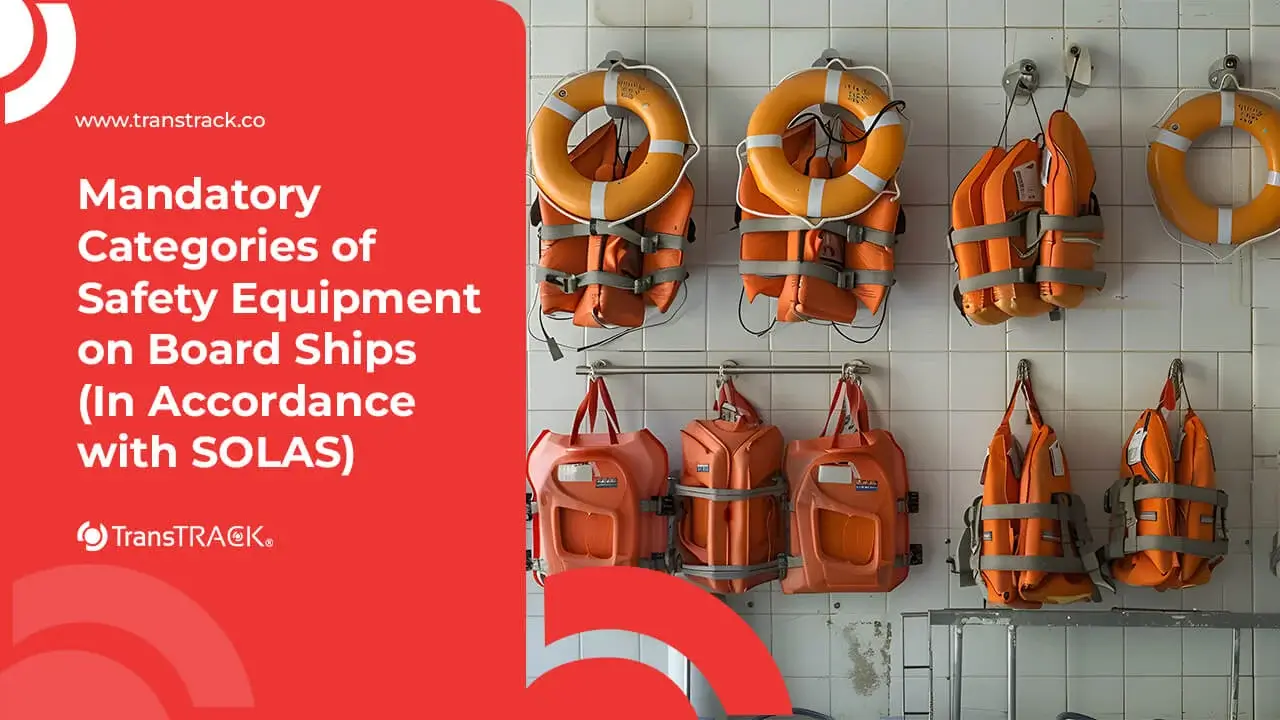
The shipping world is inextricably linked to high risks, which require safety equipment readiness that goes beyond crew capabilities. All safety equipment on board ships must comply with the International SOLAS (Safety of Life at Sea) Convention to ensure maximum and optimal protection. This article TransTRACK will categorize and explain the function of each vital safety equipment on board so that an in-depth understanding of the importance of these tools can be achieved.
Category 1: Life Saving Appliances
Lifesaving equipment encompasses not only tools for individual rescue but also safety equipment designed for groups. Each piece of equipment has a crucial function in ensuring the safety of every life, both individually and in groups, and it is crucial to understand it thoroughly to ensure optimal operation. Here are some examples of lifesaving equipment and their functions:
Group Rescue Equipment:
- Lifeboat:
- Function: Transporting passengers in the event of a threat and implementing an emergency evacuation process from the main ship, until assistance arrives.
- Types (shapes) of lifeboats:
- Covered (has a protective roof to protect passengers from extreme weather conditions)
- Open (no roof, simpler, usually used for training or simple emergency conditions)
- Notes: The importance of regular launch drills to ensure crew agility and readiness when an incident occurs and to minimize errors in the evacuation process.
- Life Raft:
- Launch type:
- Manual (launched directly by the crew by hand)
- Hydrostatic (automatically launches when submerged in water)
- Equipped with an Emergency Pack containing emergency equipment.
- Line Throwing Appliance:
- Function: Sending a rope to another vessel, buoy, or distant rescue location during an emergency evacuation or rescue.
- This tool is useful in situations where the distance cannot be reached directly by the crew (long distance)
Personal Rescue Equipment
- Life Jacket
- Comply with mandatory standards and requirements:
- Minimum buoyancy is 100 Newtons for calm waters, and 150 Newtons for open waters.
- Can automatically turn the body so that the face remains facing upwards (floating with the head above water).
- Made of water and fire resistant material, and is easily visible (bright orange or yellow color).
- Equipped with a whistle and auto light so it’s easy to find in the dark.
- Easy to use without assistance, even by children or untrained people.
- Immersion Suit
- Important for protection from hypothermia in cold waters
- Lifebuoy / Ring Buoy
- Placement of buoys:
- The main deck and sides of the ship, near the rails or railings.
- The bridge deck and open work areas are vulnerable to falling overboard.
- Stern and bow decks, to anticipate incidents at the ends of the ship.
- Must be available in sufficient quantities and clearly marked, in accordance with the size of the vessel and SOLAS regulations.
- Has additional equipment (lights and floating rope)
Category 2: Fire Fighting Appliances (FFA) — Fire Fighting Equipment
In the shipping world, the risk of fire is one of the most serious threats, endangering the safety of the ship and its entire crew. Therefore, it is crucial for every ship to be equipped with firefighting equipment that can detect, prevent, and extinguish fires early. By utilizing an adequate fire extinguishing system, a quick and effective response to threats can be carried out before the situation gets out of control. Here are some examples of FFAs:
Detection and Alarm System
- Smoke and Heat Detector
- Placement on board:
- Accommodation spaces such as crew cabins, hallways and rest rooms.
- Engine room and control room, due to high fire potential.
- Storage room for flammable materials and kitchen (galley).
- On the ceiling with a certain distance between units, and tested periodically to ensure its function.
- Fire Alarm System
- How to activate:
- Automatically: Through smoke or heat detectors that detect signs of fire.
- Manually: Press the manual call point (MCP) button which is usually red and installed on the corridor wall or strategic area.
- Once activated, the system will trigger audible and visual alarms, alerting the entire crew to immediately initiate evacuation or shutdown procedures.
Portable Fire Extinguisher
- Portable Fire Extinguisher (APAR)
- Types of APAR & their classifications:
APAR Air (Water)
- Classification:Class A(For solid material fires)
- Not suitable for electricity or flammable liquids.
APAR Busa (Foam)
- Classification:Class A & B(For flammable solids and liquids such as oil and gasoline).
- Not recommended for electrical fires.
Dry Chemical Powder Fire Extinguisher
- Classification:Class A, B, C(Versatile, suitable for solid materials, flammable liquids, and electrical equipment)
- Effective in various emergency situations
APAR CO₂ (Carbon Dioxide)
- Classification:Class B & C(Specifically for liquid and electrical equipment fires)
- Leaves no residue, suitable for server rooms or kitchens
APAR Clean Agent (Halon alternative)
- Classification:Class A, B, C(Effective and safe for electronic equipment)
- Environmentally friendly, does not damage the device.
- Hose and Nozzle
- Pressure standards:
- Working pressure:*
- Minimum 10 bar (1 MPa)
- Must be able to withstand test pressures of up to 15 bar or more, depending on the ship’s classification.
- Hose length:
- Generally 15 to 30 meters per roll, adjusted to the coverage area and ship needs.
- It must be sufficient to reach the entire protected area from the nearest hydrant point.
Fixed Fire Extinguishing System
- Engine Room CO2 System
- Evacuation procedures and working methods:
- Fire identification: Make sure the fire source comes from the engine room and cannot be extinguished or controlled with a regular fire extinguisher.
- Crew evacuation:Immediately evacuate all personnel from the engine room and ensure that no one is left behind.
- This is crucial because CO₂ can be potentially lethal to humans in enclosed spaces.
- Close the engine room: Close all doors, vents, and dampers to prevent CO₂ gas from leaking out of the room.
- CO₂ system activation: Once the evacuation process is confirmed to be smooth, manually activate the CO₂ system from the external control panel.
- Monitoring & isolation: Monitor the air pressure and ensure the area remains closed. Do not re-enter until the room is declared safe and adequately ventilated.
- Sistem Busa (Foam System)
- Used for certain cargo areas (example: tankers)
- Fire Pump
- Emergency Capacity and Resources:
- Capacity:Must be able to deliver two water jets simultaneously through two fire hoses with a minimum pressure of 0.3 MPa (3 bar) at the furthest point on the ship.
- Resource: Used separately from the main system.
- They are generally operated by a diesel engine or electric motor located outside the main engine room (so they can continue to function if the engine room catches fire).
Category 3: Navigation, Communications, and Emergency Signals
In emergencies at sea, a strong and adequate communication system is key to the rescue process. The Global Maritime Distress and Safety System (GMDSS) has emerged as an international standard that ensures ships can send distress signals automatically and accurately. This system includes various navigation, communication, and emergency signaling devices to expedite rescue responses. Here are some examples:
- Emergency Position Indicating Radio Beacon (EPIRB):
- Main functions:To automatically launch an emergency signal containing the ship’s accurate position to the satellite when an emergency occurs.DeviceThis helps the rescue team find the ship’s position quickly.
- Hydrostatic Activation:Occurs automatically via a hydrostatic sensor when the device is submerged in water at a certain depth.
- Search and Rescue Radar Transponder
- SART is needed because this device can help rescue ships or aircraft find the location of ships or lifeboats in an emergency.
- This device will reflect radar signals so that the position of the victim’s ship or lifeboat can be detected more quickly and accurately.
- The presence of SART increases the chances of evacuation and rescue.
- Pyrotechnics or Signal Flares
- Types of flares and their duration:
Hand Flare
- Used at close range to indicate position.
- Time of occurrence: 3 years from the date of production
Parachute Rocket Flare
- Lights up in the air and are visible from a distance, usually used at night or in the event of a major emergency (life-threatening)
- Time of occurrence: 3 years from the date of production.
Smoke Signal
- Produces thick orange smoke, ideal for daytime use and position marking at sea.
- Time of occurrence: 3 years from the date of production.
- Two-Way Radio (VHF Radio)
- Main functions: Maintaining ongoing communication between survivors and rescue vessels, other vessels in the vicinity, or coast stations.
- This tool helps convey the location, condition of victims, and emergency needs in real time.
Why is it mandatory to maintain safety equipment readiness?
Safety equipment readiness on board a ship is non-negotiable, as it directly relates to risk to life and legal liability. Equipment that fails to operate when needed can lead to fatal accidents and significant risk to life, while failure to comply with regulations can result in severe penalties. Here are some key reasons why maintaining safety equipment readiness is crucial:
- Regulatory Compliance:
- Legal consequences and fines of PSC inspection if safety equipment is expired or not functioning:
- Ships may be subject to temporary isolation or detention.
- Ship owners can be subject to administrative fines, be registered as serious violators, and face the risk of a decline in their operational reputation on the international stage.
- It risks disrupting shipping activities and has a drastic impact on the company’s finances.
- Accident Prevention
- Safety equipment that is ready to operate when needed and can be utilized to its maximum potential is the crew’s last line of defense.
Conclusion
Vessel safety cannot rely solely on the availability of safety equipment on board. A port surveillance system is needed that is capable of comprehensively monitoring vessel movements, detecting potential risks early on, and ensuring that all activities comply with maritime safety standards.
Port Surveillance System from TransTRACK is an integrated solution to improve the operational safety of ports and large ships through real-time monitoring, ship movement analysis, and data-driven decision support. It’s time to equip your ship’s safety tools with a modern, accurate, and reliable port surveillance system.
Improve your maritime safety standards with the TransTRACK Port Surveillance System—because safety at sea begins with proper surveillance.
FAQ
How long do life jackets last on a ship?
The validity period of a life jacket does not have a fixed expiration date, however, the life jacket must still be visually inspected annually by the ship operator and replaced if the foam or material is damaged or brittle.
What are the main international standards for ship safety?
The main international standard for ship safety is SOLAS (Safety of Life at Sea).
Where can I find an EPIRB on a ship?
EPIRBs are generally placed in an easily accessible open space on a bridge or other open area so that they can be launched automatically when the ship sinks.
How often should ship fire extinguishers be inspected?
Fire extinguishers must be inspected regularly every month and must be thoroughly tested by a certified technician at least once a year.
What to do if the EPIRB is damaged?
If the EPIRB is damaged or malfunctioning, it must be replaced immediately or repaired by a certified technician. This is because the EPIRB is a crucial piece of safety equipment in an emergency.
Recent Post




Topic :